


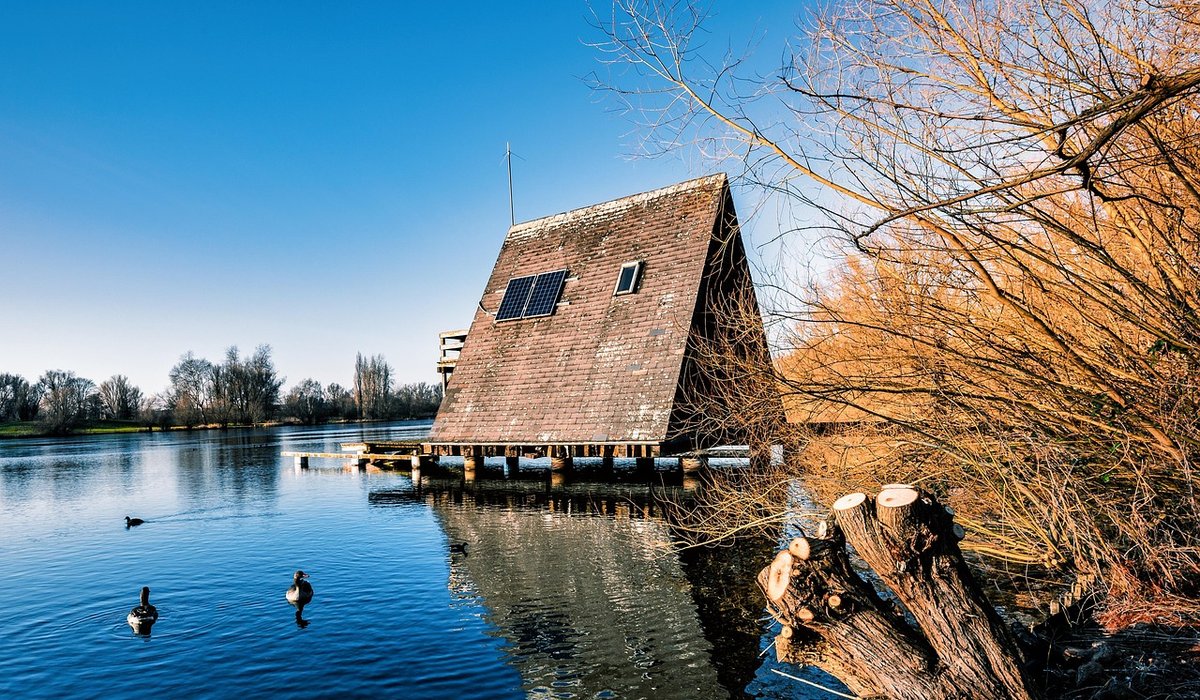
There is a particular kind of pleasure in a small building at the bottom of the garden. A hut, a cabin, a shed with a decent chair and a kettle — it offers a short journey and a complete change of scene. The trouble is that most of us try to furnish these spaces as if they were miniature houses, and within a season the floor disappears under boxes, spare chairs and half-finished projects. The answer is furniture that folds, tucks and doubles up, so a hut of eight or ten square metres can work as a study on Tuesday, a guest room at the weekend and a quiet retreat on a Sunday morning.
Start by Measuring Properly
Before buying anything, spend twenty minutes with a tape measure and a notebook. Note the internal dimensions, but also the awkward bits: the height of the eaves where the roof slopes down, the swing of the door, the position of any window cill, and the depth of the wall studs if the hut is timber-framed. A fold-down table needs a clear 75 cm of depth when open and about 25 cm when closed, so it must sit against a wall that has nothing in front of it.
Think about headroom too. A wall-mounted bed that folds down across the width of a shed needs the ceiling above it to be clear of beams, hooks and pendant lights. If your hut has a low-pitched roof, a cabin bed tucked along the taller gable end usually works better than a folding one.
- Measure door width, so anything flat-packed will actually fit through it.
- Check floor level — many sheds sit on bearers and are not perfectly flat, so adjustable feet matter.
- Leave a 60 cm walking route to the door, even when everything is unfolded.
Fold-Down Tables and Drop-Leaf Desks
A hinged table is the single most useful piece of furniture in a tiny hut. A simple flap of 18 mm birch plywood, 90 cm wide and 60 cm deep, fixed to the wall with piano hinge and supported by two folding brackets, gives you a proper desk or dining space and then vanishes. Seal the edges and give it a couple of coats of hard-wax oil or a water-based varnish, because huts are damper than houses and bare timber will swell.
If you would rather buy than build, look for wall-mounted drop-leaf tables of the kind sold for small kitchens, or a folding bistro table with a slim profile. A gate-leg design is sturdier for anything heavier than a laptop, and a table with a fold-down leaf on each side can seat two comfortably at 120 cm long.
Pair the table with stackable or folding chairs that hang on hooks when not in use. A folding director's chair takes up almost no floor space and is far kinder to the back than a stool.
Storage Benches That Earn Their Keep
In a hut, every piece of furniture should be doing at least two jobs. A bench along one wall can be a seat, a bed extension for a child, and a chest for bedding, tools or board games. Aim for a seat height of 42 to 45 cm, with a lift-up lid on gas struts so you are not holding it open with your head while rummaging inside.
Build or buy in lengths that suit the wall: a 150 cm bench with a 40 cm depth gives a surprising amount of internal volume. Line the inside with a breathable cotton or canvas liner rather than plastic, which traps condensation, and add a couple of small ventilation holes drilled in the base panel. Cushions should have removable covers you can wash, because garden huts gather dust, pollen and the occasional spider.
- Use the space under a fixed bench for deep storage of things you rarely need.
- Add a shallow open shelf beneath the seat for slippers, torches and the dog's lead.
- Choose a lift-up lid over drawers wherever floor space is tight — drawers need pull-out clearance.
Wall Beds and Clever Sleeping Solutions
If your hut doubles as a guest room, a wall bed is worth the investment. A horizontal fold-down bed, sometimes called a Murphy bed, is available in single sizes around 90 cm by 190 cm and folds to a cabinet roughly 35 cm deep. It must be fixed securely into solid framing or a properly reinforced wall — never into thin cladding alone — and the mattress should be a lightweight foam type, no thicker than about 15 cm, so the mechanism stays easy to operate.
Cheaper alternatives work well in smaller spaces. A daybed that converts from a single to a small double gives you a sofa by day; a truckle bed slides away underneath. For a shepherd's hut or a narrow cabin, a fixed single bunk along one side, with storage drawers built beneath, often uses the space better than anything that folds.
Use the Walls and the Roof Space
Vertical storage is what stops a small hut feeling cramped. Run a shelf at picture-rail height around two or three walls, deep enough for books and jars but not so deep that it looms over you. Pegboard or a simple rail with hooks keeps tools and mugs off every surface, and a magnetic strip above the table holds knives or secateurs safely.
Consider a shallow 15 cm wall cabinet for paperwork and stationery, and a hook or bracket on the back of the door for coats, aprons and a folding chair. Keep the floor as empty as you can. In a hut of three metres by two and a half, visible floor area is the difference between a room and a cupboard.
Comfort Details That Make It a Retreat
Space-saving furniture only pays off if the hut is pleasant to sit in. Insulate the roof and walls if you have not already, drape a heavyweight curtain or Roman blind across the glazing at night, and add a rug with a rubber-backed underlay to take the chill off bare boards. Choose warm, low-level lighting — a wall light above the table, a clip-on reading lamp by the bed — rather than one bright ceiling fitting that makes a small space feel like an office.
A small thermostatic heater or an electric panel heater on a timer turns a shed into a room you will use in February, not just June. Add a lidded basket for blankets, a small bin with a tight lid, and a tray to gather cups and crumbs at the end of the day. Do those few things, and a hut the size of a decent garden bench will feel generous — a proper retreat that happens to fit neatly at the end of the path.


Leave a reply